Oh, where to begin...
Tannhauser wrote:Fact : At that distance, you'd be dead long before even hearing or seeing the atom mushroom spreading. The heat would just melt anything over the whole map to the point it would be a flat molten land.
[quote=""'[R-PUB"]MrD;650185']On the size of current maps, unless the biggest map available, even a battlefield nuke might just vaporise the entire landscape in mere seconds.[/quote]
Gentelmen, please join me for a sesion of Nuke 101, where we will attempt to unbrainwash you from years of liberal media exposure that a nuke would be instant death to all.
1st off, a Nuke is nothing but a very big bomb, nothing magical about its effects on you and the area where is it detonated. The radiological effects of a nuke are mostly contained to the initial blast radius. Any bomb bigger than 1kt you will be killed by the blast effects before radiation sickness gets you if you are in the blast zone. Fallout is a special problem, if you are down wind of the bomb you are in trouble when the fallout hits, but there is time for you to move, and closer to the bomb (especially small nukes) the plume is small and easily avoided (its more of a problem when you are dozens or more miles down wind or don't know exactly where the bomb went off).
2nd, if we are talking about an easily portable warhead (nukes are very heavy and hard to transport) we're not talking about megaton yields. The W-54 warhead used in the David Crocket initially had a yield of 10-20 tons,

and in its final incarnation (the infamous back pack bomb) was selectable for 10-250 tons. By compairison, the fertilizer bomb used at the Oklahoma Federal Building had a 5 ton yield, it certianly didn't vaporize the entire city, it didn't even take down the whole building. The recent test blast of the Russian "Father of all bombs" yielded 44tons, more than twice the initial power of the Crocket.
Here is the "suit case" bomb pack
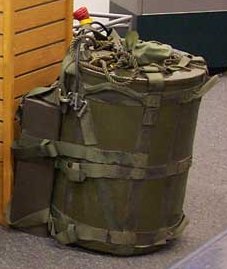
For argument's sake, lets use the Russian test resulted as a benchmark and call it a 40ton yield bomb. That results in a 300m lethal blast radius, on a 4km map that would result in a kill area of .07sqkm, or 4 tenths of one percent of the map, hardly wiping the map. In fact, I'd be willing to bet the current configuration of the JDAM in game is close to that.
Within the time scale of the game fallout would not be an issue (it takes time for radiation sickness to show up).
It would take a bomb of more than 60Kt to do serious damage to the entire 16sqkm map, but these weapons are far too large to be easily transported.
[quote="Enderjmu""]Anyway, with a nuke, anything within 5 miles is vaporized, 20 gets the 200 MPH winds, and anything beyond that gets a ton of radiation in the stratosphere...[/quote]
You'd need a yield of 35Mt to achieve a 5 mile blast radius with an overpressure of 15psi (enough to destroy all structures, not make a hole that big). The largest bomb built by the US, the B-41 was 25Mt, it was 12 feet long, 4 feet wide, and weighed 10,000lbs. It was so big there were only 2 planes that could carry it (B-52 could carry 2 and B-47 which could carry just 1). Not the sort of bomb terrorist could smuggle around.

Ghost1800 wrote:Maybe it's just me... but don't you think WMD disarmament would be a special forces job?
Not really, the troops charged with handling nukes are not SF, they are WMD techs or Nuke techs. If the allied forces knew about a nuke in the area they would certianly have a nuke team activated and brought to them. No doubt, SF would be brought in to secure the bomb, simply because of the extreme urgency of the situation, but they would not be required. For the purposes of the game, the nuke techs could be NPC's, we'd have to secure the nuke and let them go to work.
Conventional nukes are not that hard to disarm (arming is much harder and is part of the protection built into the whole bomb thing).
DannyIMK wrote:in real life i dont think that armys using nukes agaisnt insurgents..
You sir are absolutely correct, however if Osama got ahold of a nuke you can be assured we will be the first to know, and it would be in the form of a mushroom cloud.



 and fastropes on blackhawks!




 *snip* hmm.... *Boom*


