causticbeat wrote:Maybe im wrong, but IR =/= Thermal if I recall
This is not entirely correct, but not totally false. Let me explain (sorry, long - I really feel like posting long **** tonight

).
IR refers to Infrared; Infrared light is the light in wavelengths (colors if your prefer) outside of the visible spectrum, at lower energies. Basically (and very simplified, from lower energy to higher energy:
Radio waves - Microwaves - Infrared light - Visible light - Ultra Violet Light - X Rays - Gamma ray
Actually, here's a picture:
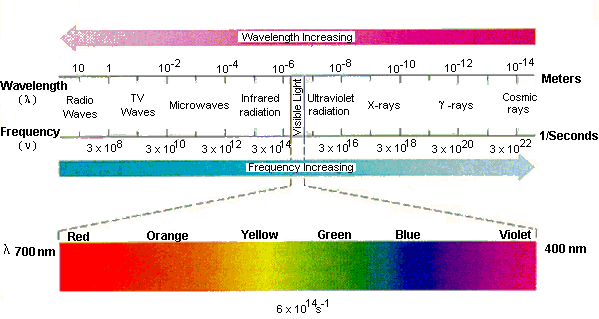
The idea is that any object emits radiation. The more energy the object has, the hotter it is, the more radiation it will emit and higher the energy of that radiation will be (hence shorter wavelengths). That's plank law cut short with round corners.
So, anything that's hot (i.e. not at 0 Kelvin [-273°C]) will emit radiation. Under about 700°C the radiation emitted is mostly in the Infrared. At higher temperature, you'll start seeing visible light. For example, a light bulb (very hot) will emit heat, but also visible light.
An Infrared camera allows you to see light in the infrared spectrum... but that spectrum is very long. It is split in two categorie : Long wave IR (far IR) and shot wave IR (near IR); Near and far as in near or far from the visible spectrum. A camera sensible in the near IR will only see clearly very hot heat sources, source probably hot enough to be visible. This band is not usually used for what we call thermal imaging because colder objects emit almost no light in that region. The region were you can clearly see a difference between objects objects having different temperatures near the normal room temperature is situated in the Far IR. This region is also called the thermal IR because it is often used to measure temperature and used to monitor heat sources and identify hot spots in fires.
In night vision system, what we usually call IR system are system in the near IR and are usually coupled with light amplification systems and illumination systems (most likely at wavelengths around 800 nm, same wavelength as a TV remote). Thermal night vision system are usually around 10-12 um (micrometer) wavelengths.
So while both system are Infrared (IR) systems, we generally use the name "thermal" to specifically point to the long wave IR (far IR).
Here are a few typical shots in near IR:


And here are a few typical shots of far (thermal) IR:


The last one is nice... You can see how the cold-blooded lizard warms up in the sunlight.
Bonus:

TF6049 wrote:Exactly. It's separate from vBF, so EA will say "whatever, as long as you don't use it on a ranked vBF server". And, if its dev-endorsed, it should be fine.
For MS flight simulator, i've been flying on very realistic models. The simulation (incl. flight dynamic) is almost totally working on external .dll that come with the aircraft model (a commercial addon you need to buy). I've never seen a mod in other games do that: use external program to run things like ballistic calculations. I've also never seen a mod using a hook officially to bypass engine limitations.
Although this would be very interesting and ingenious, it is most likely forbidden by the original game EULA, allowing only modification to the extend the game developers wanted.


 :
: 1 of the reasons u got me into to testin, but i never posted it cos we were to busy with .6 testin
 and if you were Armed or not i think he said something about them not working if you looked at glass?