
No...wind resistance does not change the constant force of gravity.[R-CON]nedlands1 wrote:
Gravity pulls all the time. The round is always effected by gravity... If you fire a round horizontally and drop one from the same height, the rounds will hit the ground at the same instant. With slow moving round, gravity has more time to act upon it, pulling it down far more then a fast moving round. The same thing applies with wind from the side. You need to compensate for wind far more with a slow moving frisbee then a speeding bullet.
EDIT: Speed is not synonymous with force, some would say like you and being a physicist.
Yes the force of gravity is a constant.
But....the speed/velocity of a round changes from the point of triggered fire until it it lands.
It leaves the barrel at maximum velocity and slows over distance due to resistance, making it vulnerable to the constant pull of gravity.
Your bullet drop scenario is very incorrect as well.
I will keep it as basic as possible so you can follow along.

A 50 cal round can be placed on target at distances of 2+ miles away.
The Barret M82A1 has a maximum range of 6800m.
1m = 3.2808 ft.
1 mile = 5,280 ft.
So...
6800m = 22,309.44 ft.
22,309.44 ft. = 4.225 miles.
So a 42.8gram 50cal. projectile, powered by a 660 grain load, traveling at 2,850 ft. per second....would take 7.827 seconds to travel a distance of 4.225 miles.
7.827 seconds
Since gravity is constant, and exudes its force on all objects regardless of size, shape, or weight...any two objects can be dropped and will fall at the same rate. For instance, I could drop a bowling ball and an ink-pen and they will hit the ground at the same time. The only factor is wind resistance. This is what keeps a feather aloft when dropped. If the feather and bowling ball were dropped in a vacuum...they would strike the floor simultaneously.
7.827 seconds
With that...you can take any object with any mass, with little to moderate wind resistance...and drop it anywhere from a height 6 or so feet, which would be the height of Joe Average shooter...and time the drop to see how long it takes to hit the ground after release.
Try it...I'll wait.
Okay? It takes a little over 1 second from release to hitting the floor.
Thats quite a bit less than 7.827 seconds wouldnt you agree?
This proves that the speed/velocity of a fired round is indeed a greater force for a matter of seconds, than that of gravity.
Once speed declines, the bullet's becomes effected by the constant force of gravity.
How do you think Rockets are able to travel into outer space?
The thrust from the rockets are far greater than gravity's pull.
This thrust remains constant and directionally upward so the initial speed is slow....until the rocket is free of earths gravitational pull. It explains why you cant throw a baseball into outer space. The baseball when thrown straight up, starts out with enough power to leave the pull, but loses velocity, loses momentum, and then becomes subject to gravity and falls back down to the ground.
Physics are definitely involved...as well as basic math.
Maybe you should study both before you post again relating to this subject.

Edit: I want to point out to all...that I meant no disrespect to nedlands1, nor was I trying to be "condescending"...at least no more than his post was. LOL



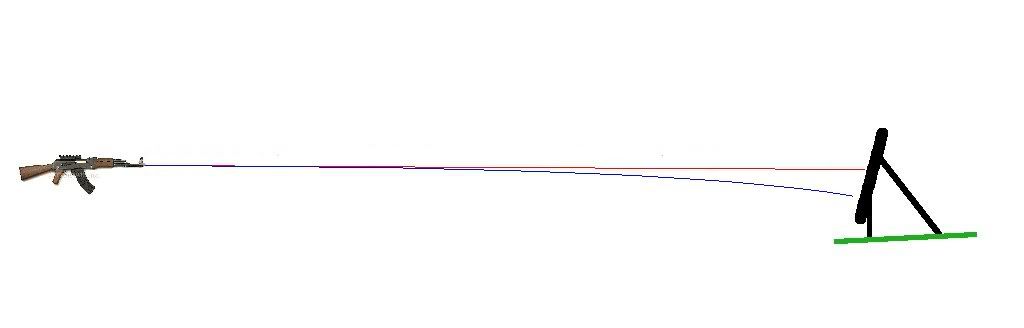
 I like mine better...

