1.1 – Defining Mechanized Infantry
Often times in Project Reality APCs are used as stand alone “light tanks” or as a simple shuttle for Infantry squads coming out of the Assembly area. A mechanized infantry squad is a squad that works in close conjunction with an APC squad to work towards a common objective. This guide is intended as a reference for how to best coordinate squads to effectively use APCs and Infantry squad elements. Different size Mechanized Infantry elements can be used depending on the situation and available equipment. I have seen both a single APC with infantry used effectively as well as four APCs with two infantry squads. It is up to the player to determine in what size and consistency is needed depending on the battlefield situation and objectives. This guide is meant to outline a optimal mechanized infantry doctrine and then adapted to a battlefield situation If used properly, mechanized infantry can quickly overrun enemy positions and seize objectives before a coordinated counter-attack can be launched.
1.2 – Doctrine
A Mechanized Infantry element in Project Reality is intended as a highly mobile, quick strike force. It takes advantage of it’s superior ability to cross distances and its ability to quickly deploy a combat squad to an area of operation and mutually support each other in completing an assigned objective. APCs, while powerful assets in Project Reality, are best use in the role of their intention –transporting and supporting infantry. The Infantry Element usually travels with less limited equipment (i.e. it is a light infantry unit) and focuses on its mobility and firepower to overwhelm defenders.
1.3 Prerequisites
This guide assumes that the players involved in a Mechanized Infantry Unit are already experienced in the basics of squad leading, communications, and vehicular usage. This guide is mainly focused at the squad leaders of the two squads involved in a Mechanized Infantry element. If you feel the need to brush up on any of the topics, I recommend these guides:
Squad Leading Tips:
https://www.realitymod.com/forum/f143-s ... 0-8-a.html
Armored Personnel Carrier Tips:
https://www.realitymod.com/forum/f139-a ... guide.html
Communications and VOIP Guide:
https://www.realitymod.com/forum/f143-s ... owder.html
2- Organization
2.1 APC Squad Organization
The most common configuration for APC squads - since most maps contain APCs in pairs - consists of four crewmen and two attached engineers. When spawning, everyone should ALWAYS select “engineer” as their kit. The squad leader should designate a team leader for the second APC as well as his gunner. Both the squad leader and the team leader are the drivers of their respective APCs. The driver does not have to focus on the engagement as much as the gunner of the APC does, so he can better relay information, listen to orders, and in the case of the squad leader, mark targets both on map and for the team via the commander. One engineer should attach to each APC for assistance in field repairs, door breaching, mine clearing, and other duties. Engineers are not a necessary element of the APC team of the mechanized infantry element – you can get by without them - but they are extremely important to bring along, as they can prevent headaches down the road.
2.2 Infantry Squad Organization
The infantry squad is setup like a standard infantry squad, with a few key changes. Firstly, the squad needs to be split into two fireteams. It is often a good idea for the fireteam leader to have squad leading experience, as his team will act in some respects on its own. Second, the Infantry Squad differs from a standard infantry squad in that it doesn’t take “heavy” kits that Infantry squads sometimes take. Because the Infantry Squad tends to be highly mobile, and are often required to constantly maneuver under fire, it is strongly advised to avoid kits like: Heavy AT, Snipers, Marksmen, Anti-Aircraft, etc. The infantry don’t remain stationary enough to use these kits effectively. Other standard infantry squads should be left in charge of the other kits. The details of the exact load out of the squad fall to the squad leader and depend on the situation. Some squad leaders prefer to leave behind the Automatic Rifleman kit since the APCs themselves more than make up for the firepower of a LMG. Some prefer to bring to grenadier kits instead or sometimes a second medic to augment each fireteam. It truly falls on the squad leader to make a good decision on the makeup of his squad based on the situation and the objective of the team. Keep both fireteams balanced and
The Squad Leader’s fireteam should mount on the APC not manned by the APC squad’s leader (APC 2). This will ensure that the Infantry Squad Leader will remain in the relatively safer second APC. If the team gets ambushed, usually the lead APC will be targeted first, giving the Infantry Squad Leader time to dismount and set a new rally point, and organize should things begin to get ugly. The other fireteam should mount on the lead APC 1 that contains the APC Squad’s leader.
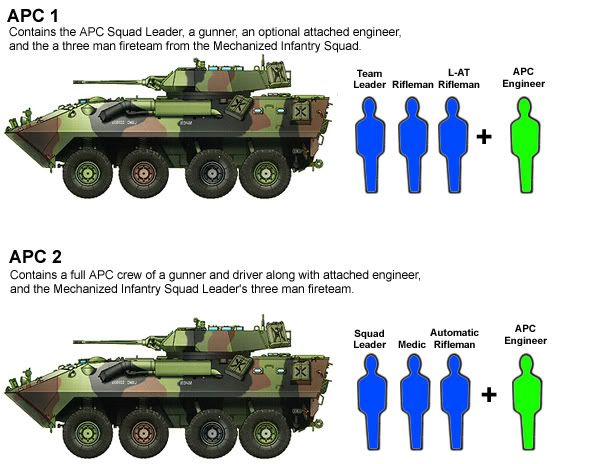
FIGURE A- An example loadout and organization of the two the squads. Note how the squad leaders from each squad are in opposite vehicles. The kit makeup of each fireteam should be determined by the squad leader prior to departing the assembly area. In this example, the squad leader's element is used as a "fixing" element and the second fireteam is used as the "flanking" element.
2.3 Communications
Unfortunately, the Battlefield engine does not support “cross-squad” communication. This means that information between the infantry element and the APC element would either need to be typed or relayed through the commander. To overcome this and to be successful, the squad leaders from both the APC squad and the Infantry squad should join a VoIP communication device (Ventrilo, Teamspeak, etc) to overcome the lack of cross squad communications. The same VoIP rules should remain in place, as both squad leaders workload is doubled when coordinating so closely with another squad. To increase “situational awareness”, it is also a good idea to bring the team leaders from both squads (Bravo Fire team and the APC 2 driver) onto the VoIP program, but have their mics muted. Both squads can communicate and spot targets to the commander of the team, but for simplicity purposes it is a good idea to designate a “leader” of the Mechanized Infantry Element. Usually the APC Squad Leader can best coordinate with the commander.
3- Deployment and Movement
4- Combat Tactics
5- Withdrawl and Resupply
6- Conclusion
-Still a WIP, toss in any feedback or ideas you want.


 .
.