You poor sodGoreZiad wrote:I remember that game

M.

You poor sodGoreZiad wrote:I remember that game



You wore a 3lbs helmet, a 35lbs vest, countless pounds of other gear, and carried a 9lbs rifle, fell off your bicycle going 20km/h, and were unscathed? Amazing.qaiex wrote:
Also when jumping out of a driving car, I think we've all fell off of bikes and skateboards and inlines and stuff when we were kids, going like 15-20km/h you get banged up but it's hardly lethal like in the game.
Especially with all that gear.
I'm sure he would be perfect with all that gear, and you might get a boo boo without gear and if you are 5 going that slow.ReadMenace wrote:You wore a 3lbs helmet, a 35lbs vest, countless pounds of other gear, and carried a 9lbs rifle, fell off your bicycle going 20km/h, and were unscathed? Amazing.

Have you ever noticed how when on ship boarding operations, soldiers (Navy SEALS EVEN!) wear bicycle/skateboard helmets? That's because these helmets are designed to protect your head from large things (The ground, or in ship boarding, bulkheads.) moving at low speeds (But really, it's you moving at the low speed, not the ground/bulkhead.) Ballistic helmets are designed to absorb the impact of small objects (BULLETS) moving at high speeds. Anyone with a brain in their head will know that these two things are not interchangeable; a bicycle helmet will not stop a bullet, nor will a K-Pot help a whole lot when your head hits the ground.qaiex wrote:Yes, helmet, countless pounds of gear that takes the damage instead of your body, it all works like padding.
And I do not believe you bleed to death from a sprained ankle.
If you just hit the ground and start rolling, what exactly would be the damage, physically?
You might get very disoriented but thats about it.
I watched a sniper get his head pushed about by a tank on Qinling the other day.. He got up afterward and patched himself. I lol'd.qaiex wrote:Good point, but I still say it's a bit overzealous at this point, you can't jump down anything or get out of a car unless it comes to a complete stop, and I actually had someone run into me on a server yesterday and I lost health, I mean seriously.
That happens in vanilla, just you dont bleed out so you dont really notice.qaiex wrote: and I actually had someone run into me on a server yesterday and I lost health, I mean seriously.

Hm, what did you do to break it? Jump down a sidewalk ledge? ;pGoreZiad wrote:Mmmm.. Lactose. Just got out of the hospital with a broken ankle, they gave me a drink of that every evening


The problem with this is that with the level of horizontal mobility given to players in project reality, which, IMO, is far greater than that you would have if you had all the gear on you described, when players are shown the hard way the limits to vertical mobility, they complain.[R-DEV]Gaz wrote:hmmm. Ever tabbed with full kit on? As in FULL battle scale? Ever jumped off a high sided troop carrier with full kit on? You are carrying hundreds of rounds, grenades, smoke, medpack, radio, batteries, rifle and whatever bits are attached to that (ugl), grenades for that, kevlar helmet and body armour. Jumping 7ft will either sprain/break your ankles or you will damage your knee ligaments. Or collapse in a heap of sh*t.
If you try to do a kinky little roll with that kit on, I'll applaud you myself. Then laugh. You can do that on a para decent, because you HAVE to, and you're kit's underslung, not wrapped round you.
I see your point, however we tend to be rather physically robust and fit as Infantry. Under fire, you'll run like poop off a shovel due to adrenalin.Duckmeister| wrote:In layman's terms, when players can run fast and long, but not fall off something seven feet high without getting damaged, there's a stark, unrealistic contrast and players complain.
One thing, though.[R-DEV]Gaz wrote:I see your point, however we tend to be rather physically robust and fit as Infantry. Under fire, you'll run like poop off a shovel due to adrenalin.
However, when jumping from even a reasonable height with weight on, momentum and ultimately gravitational pull (including the dead weight you are wearing as kit) all act together to act much the same as a car crash, with an object coming to an immediate or rapid stop. You. The weight due to gravity is magnified due to the velocity of your desent, and you basically have an average 14 stone soldier's legs taking an immediate impact weight equivalent of a lot greater than what it's used to.
Even fit muscles tear/rip under this sharp impact trauma.
Ha! Thats pretty much the commanders job now.GreedoNeverShot wrote:
Where's your radios? Spare batteries? Various bits that need manpacked and cannot be spoken of on public forums? Humvees doing 5mph aren't exactly 7ft drops onto concrete or uneven ground. I'm talking from personal experience too, and I'm going to hazard a guess that that patrol you have pictured has vehicles in support to drop kit in. Not a foot patrol. If you are advancing to contact, you wouldn't last very long in terms of needing a resupply very quick. There's a big difference between manpacking kit and having a vehicle to dump stuff inBlakeman wrote:I'm at odds with this one. On one hand the folks bring up good points, yet they fail to bring in the fact that in real life you often don't have your full pack on while on patrol.
Helmet, Vest, magazines, weapon, other bits and a camelback. I know I've jumped out of humvees going 5 mph with this on and been fine, wasn't graceful (that's just me though) but nobody else suffered any huge knee shattering trauma. Keep in mind I was the SAW gunner.
This is especially true with dedicated transport, since that is where you pack is if on extended patrol.
I often wonder also why there are packs as a rally point if we still have them on our backs, but I know this is just a graphical representation.
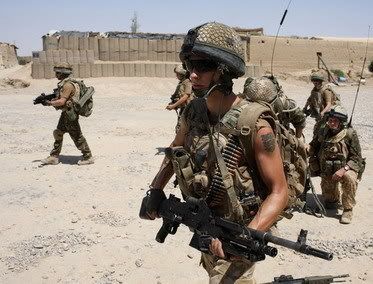
Going for sensationalism there were we? Damaged ligaments take soldiers out of contact, meaning you're a bayonet down. I did not suggest their kneecaps would explode, so ease up on the amateur dramaticsBlakeman wrote:but nobody else suffered any huge knee shattering trauma

Your argument is flawed. Adrenalin makes you run fast even though you're exhausted. Which you will be, mentally and physically after about 10 minutes of contacts. The average firefights are lasting 4+ hours in Afghanistan. It doesn't miraculously stop you getting injured, which is what you suggest. You jump off a wall onto concrete or uneven ground, or even flat grass, and you still run a high possibility of doing physical damage. The adrenalin may offset that pain, but it won't suddenly heal the damage for you.Duckmeister| wrote:One thing, though.
If you say adrenaline makes you run faster with all that gear on, why can't it prevent injury for a small fall?
Ever jumped off a ledge when someone was chasing you? Yes, it hurt your feet, but:
1. It didn't start the hard-to-control bleeding process that happens when you fall off a ledge in PR.
2. Because of the increased awareness gained by adrenaline rushes, most people know enough to handle a small fall, by crouching and balancing the weight between multiple points instead of their ankles.
Soldiers are trained to handle vertical as well as horizontal movement. Most people know that crouching helps distribute weight.
Your statement would hold up if soldiers were taught to fall flat-footed, which would indeed break their ankles and tear muscles.
LMAO, I've been serving 10 years, 7 of them as Air Assault, and I've obviously missed the vertical movement training we get trained on. Seeing as I run a lot of my unit's training, it seems someone has forgotten to mention that one to meDuckmeister| wrote:Since you compare the fall to a car crash, I'll try to explain it in those terms.
When a car crashes into a wall, does one point on the front of the car take all the damage, or does the whole front of the car take a lesser amount of damage?
When someone falls flat-footed, they are obviously putting all of the impact with their extra weight in gear and ammunition directly on their ankles, which will indeed cause injury. When someone falls properly, that weight can be distributed evenly along different points in the ankles, calves, knees, hip, therefore not causing any injury, although with enough weight it will hurt.
The most important thing to remember is that 7ft isn't enough to get a 180 pound plus 80 pounds of gear object into terminal velocity. He's not going that fast.
I, personally, would be happy if the system was changed so that falls below 10ft lowered health but did not cause bleeding.
Or do you mean the 6ft wall that you scale then jump off? With no kit on and your skid-lid on for safety reasons...That is not important at all. I wasn't suggesting reaching 100mph+ drop speeds. Crash a car at 30mph with no seatbelt on and experience the forces at work on your body. You'll still be thrown forward and hurt yourself. The whole POINT is that a 7 ft drop with a mass of 260lbs of kinetic energy coming to a complete stop is more than enough to do damage that may take that soldier out of the fight due to injury.Duckmeister| wrote:The most important thing to remember is that 7ft isn't enough to get a 180 pound plus 80 pounds of gear object into terminal velocity. He's not going that fast.
No, the kinetic energy travels through the direction of least resistance. Legs vs ground. Ground wins. The force in which you hit it from that height with that weight will make you bend your knees from trying to absorb the shock so much that you will lose stability and fall over. It's the shock travelling up your legs.Duckmeister| wrote:When a car crashes into a wall, does one point on the front of the car take all the damage, or does the whole front of the car take a lesser amount of damage?
Point proven I assume?from the piece above wrote:Individual Marine combat loads – including protective gear, weapons, ammunition, water, food and communications gear – range from 97 to 135 pounds, well over the recommended 50 pounds, a 2007 Navy study found.
In Afghanistan, soldiers routinely carry loads of 130 to 150 pounds for three-day missions, said Jim Stone, acting director of the soldier requirements division at the Army Infantry Center at Fort Benning, Ga. In Iraq, where patrols are more likely to use vehicles, loads range from 60 to nearly 100 pounds, he said.