Ok well first, I read the already suggested and it wasnt under Scoped or RPG so I thought it wasnt said yet, sry.
As for the ammo facts,
-----------------------------------------------------------------
ThermoBaric:
The term thermobaric is derived from the Greek words for “heat” and “pressure”
A thermobaric weapon (or solid fuel-air explosive) uses the gaseous products (H2, H2O, CO and CO2) of an initial explosion for an afterburning of reactive solids. Because their reaction with atmospheric oxygen only produces solid oxides the blast wave is primarily generated by heat of combustion ("thermobaric") instead of expanding explosion gases. This makes thermobaric explosives more effective in oxygen deficient environments such as tunnels, caves or underground bunkers.
Rather than providing protection as they would from conventional explosive ammunition, structure interior walls, particularly cement or other hard surfaces, magnify and channel the shockwaves created by a thermobaric detonation. The stronger the walls, the higher the pressure’s reflective effect. The turbulent mixing of fuel with ambient oxygen is induced by the presence of walls through enhanced mixing from three different types of instabilities as well as from enhanced chemistry from temperature and pressure velocity gradient in differing fuels,creating a piston type afterburn reaction in enclosed structures.[1][2][3]
Mechanism
A thermobaric explosive consists of a container of a finely powdered solid fuel of differing particle size mixed with a low percentage of oxidizer and binder. The solid fuel could be an explosive metal powder or reactive organic. A high explosive charge is placed in the middle of the mixture.
A thermobaric weapon is initiated upon dropping or firing, and the explosive charge (or some other dispersal mechanism) bursts open the container and disperses the fuel in a cloud, and ignites the mixture in a single event.[4] The heat released by the oxidizer gases then helps ignite the smaller solid particles that are mixed with the compressed hot air behind the shock, which leads the blast wave. This sustains a hot environment which allows 100% fuel combustion to be achieved. If fuel particles have a size distribution, smaller particles are quickly ignited, providing heat for the combustion of the larger particles. Smaller particles burn rapidly and remain tied to the local gas, while the larger particles move more freely and mix with new oxidation sources, allowing a more sustained combustion than would be produced by particles of a single size.[5]
In confined spaces, transition to full detonation is not required for enhanced blast, if the solid fuel is ignited early in the dispersion process. A series of reflective shock waves generated by the detonation mixes the hot detonation gases with metal particles and compresses the metal particles at the same time. These actions provide the chemical kinetic support to maintain a hot environment, causing more metal to ignite and burn. This late time metal combustion process produces a significant pressure rise over a longer time duration (10–50 msec). This is a phase generally referred to as after burning or late-time impulse which can occur outside of where the detonation occurred, resulting in more widespread damage.[6]
This is an aerobic reaction that draws in all of the unburnt fuel and atmospheric air, and creates a vacuum in the detonation environment. An air shock wave, generated during the fireball expansion, is reflected from the walls of the structure. The reflected shock plays two important roles. First, it stops the temperature decrease of the air and the fireball. It can actually increase the temperature in some places, depending on how the shock waves reflect. Second, it creates two new types of flow instabilities; Richtmyer-Meshkov and Kelvin-Helmholtz instabilities.
Weapon effects
Fuel-air explosives represent the military application of the vapor cloud explosion and dust explosion accidents that have long bedeviled a variety of industries. An accidental fuel-air explosion may occur as a result of a boiling liquid expanding vapor explosion (BLEVE), for example when a tank containing liquefied petroleum gas bursts. Silo explosions, caused by the ignition of finely-powdered atmospheric dust, are another example.[8]
The detonation of thermobaric explosives (TBX) can be viewed in three stages. The first, an anaerobic stage, is measured in microseconds and breaks down the explosive by a shock wave. The subsequent exothermic molecular reactions go on to propagate the detonation wave. The second stage, measured in hundredths of microseconds, is also anaerobic. This involves reactions between any products that were too large to be involved in the main detonation event. The third stage is aerobic and lasts milliseconds. In this stage more, previously unreacted, fuel particles react with the surrounding air.[9]
Stage One defines the HE's high-pressure shock effects (such as propelling a metal liner or fragments); Stage Two prolongs the high-pressure blast pulse, giving a useful heaving effect needed in building or bunker defeat; and Stage Three produces a long-duration, lower-pressure pulse that can also have a high thermal output, both of which are useful for materiel and personnel defeat.
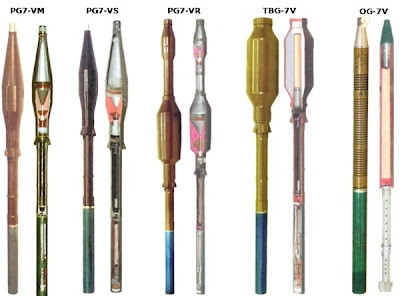
The Soviet armed forces also developed FAE weapons, including thermobaric warheads for shoulder-launched RPGs (RPO-A Shmel Bumblebee /Russian: РПО-А "Шмель"/). Russian forces have a wide array of these weapons and used them against Chinese forces in a 1969 border conflict, and used them in Afghanistan and in Chechnya[citation needed].
Russian troops report that a single RPO-A round in an urban environment has an equivalent effect to a 152 mm artillery round
Com.org - Only the best links ...