

But there's one problem - and it's the players. The tank drivers to be more specific. On maps like Kashan Desert, people tend to drive the tanks on top of the mountains to get a "good view" of the battlefield. Sure, you can overwatch a big area and spot enemys fast - But! The enemy can see you just as good as you can see them, and you might soon find yourself fired upon by alot of enemys, and you can't engage them all at the same time. In real life, one basic rule for tank drivers is to stay low and drive below hills and other heights. This means you will be harder to spot for enemy ground forces, and you will also have the ability to "pop out" and surprise the enemy.
This is what Dslyexcis TTP says about tank driving:
And this is what his OFP- guide says:The tank driver...
* Moves in a tactical fashion from cover to cover or concealment.
* Locates and positions the tank in hull-down positions when possible.
* Scans the front for mines, satchels, IEDs, and other threats.
* Listens to the commander or gunner for movement orders.
* Stays alert of friendly infantry positions and attempts to avoid them. The driver should also attempt to communication his intent to reverse when in tight terrain with infantry nearby (ie MOUT).
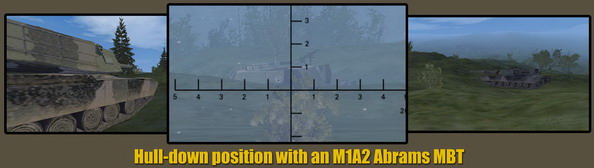
"Hull down" is the term used to describe when a vehicle (typically a tank) uses the terrain in such a way that only the gun/turret is visible to enemy forces. This provides the enemy with a smaller target, protects the more vulnerable parts of the vehicle from enemy fire, and allows the vehicle to fire more or less unhindered. The illustration below shows an M1A2 tank in a hull-down position behind a small rise. From this location, the tank had perfect visibility of a major enemy avenue of approach and had a clear line of fire down that approach without having to expose anything more than the turret to enemy return fire.
[BIGGER VERSION OF THIS PICTURE]
Hull down positions can be used by any vehicles that have weapon systems atop them - even a HMMWV with a TOW can benefit from a hull-down position, though not nearly so much as a tank might.
In the best-case scenario, a tank can utilize a hull-down position when firing, and then retreat back below the cover (i.e. down the slope that provides the 'hull-down' possibility in the first place) to total protection during the reload before popping back into a hull-down position for the next shot.
Remember that a hull-down position is relative to the location and distance from the enemy. The greater the distance of the engagement, the more likely you can get into a hull down position even in a small elevation decrease.




![[BIGGER VERSION OF THIS PICTURE]](http://dslyecxi.com/images/ofp/ttp/abrams_hull_down.jpg)